Cloud Hosting vs. Traditional Hosting: Which Should You Choose in 2026?
Introduction: A Decision Every Growing Business Eventually Faces
At some point, every growing team hears the same suggestion: “We should move to the cloud.”
For some, it represents an exciting step towards modernisation. For others, it triggers genuine hesitation — especially when existing infrastructure is running reliably and a migration feels risky. That tension is entirely normal, and it reflects a real strategic question.
Cloud hosting vs traditional hosting is one of the most consequential infrastructure decisions a business can make. This guide breaks down every major factor — scalability, cost, reliability, control, and speed — so you can make a confident, informed decision for your business in 2026.
What Is the Core Difference Between Cloud Hosting and Traditional Hosting?
Before comparing the two, it is important to understand what each model actually means:
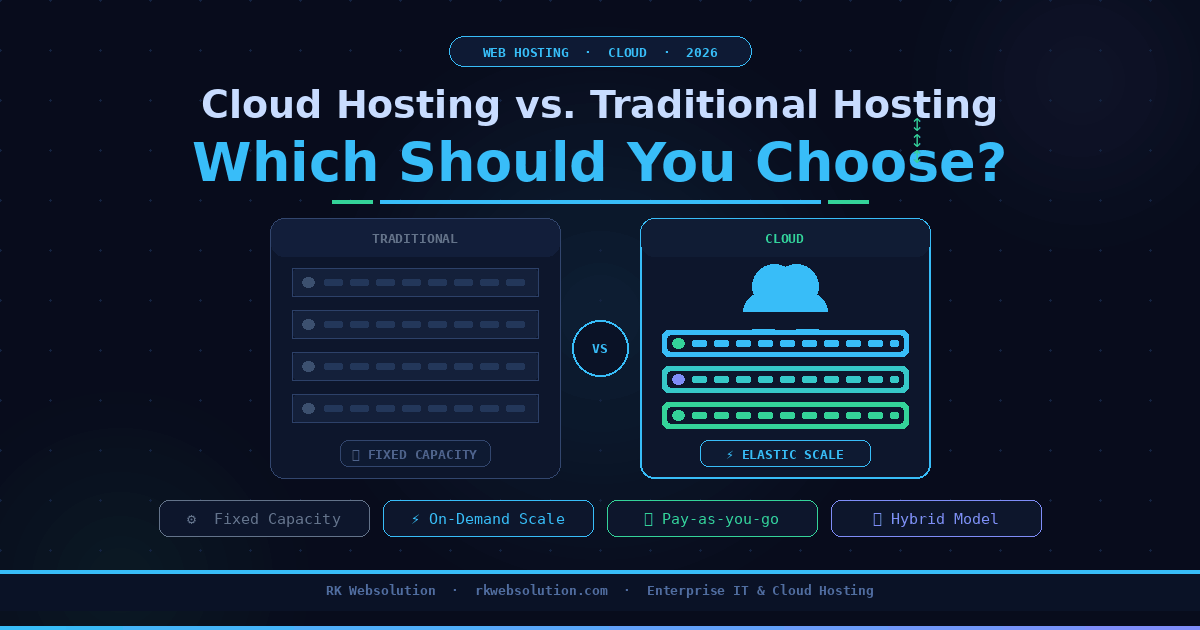
- Traditional Hosting (On-Premise / Dedicated): Your infrastructure is fixed. Hardware is purchased, provisioned, and managed in advance — either in your own data centre or through a dedicated hosting provider. You have full physical control, but capacity is locked in.
- Cloud Hosting: Your infrastructure is virtualised and elastic. Resources — CPU, RAM, storage, bandwidth — are drawn from a shared pool and scaled up or down on demand. You pay for what you use, not what you own.
The real-world impact of this difference becomes clear the moment your business faces growth, a traffic spike, or an unexpected change in workload requirements.
1. Scalability: Fixed Infrastructure vs. On-Demand Resources
Scalability is the most immediate and practical difference between the two models — and for most businesses, it is the deciding factor.
Traditional Hosting Scalability
- Capacity must be planned and purchased upfront based on anticipated demand
- Scaling up requires procuring new hardware, configuring it, and integrating it into your environment
- This process can take weeks — sometimes months — and often requires significant downtime
- The common result is over-provisioning: purchasing hardware powerful enough for your peak load, which then sits idle 80 to 90% of the time
Cloud Hosting Scalability
- Resources scale vertically (upgrading the size of a single server) or horizontally (adding more servers in parallel) in minutes or seconds
- Auto-scaling rules can be configured to respond automatically to traffic increases — no human intervention required
- You never need to pre-purchase capacity “just in case”
- Traffic spikes — from a product launch, a viral post, or a seasonal sale — are absorbed without degradation in performance
The Verdict: If your workload is unpredictable, seasonal, or growing rapidly, cloud hosting has a clear and definitive advantage. If your workload is completely stable and predictable for years ahead, traditional hosting may be sufficient.
2. Cost Model: Capital Expenditure vs. Operating Expenditure
Cost is the most frequently misunderstood factor in the cloud hosting vs traditional hosting debate. The comparison is not simply “which is cheaper” — it is about which cost model fits your business.
Traditional Hosting Cost Model (CapEx)
- Requires significant upfront capital expenditure — purchasing servers, networking equipment, storage, and physical infrastructure
- Long-term costs are more predictable and easier to budget for
- However, the over-provisioning problem means you are often paying for capacity that is never fully utilised
- Additionally, hardware depreciates. A server bought today may be functionally obsolete in three to four years — at which point you face another capital expenditure cycle
Cloud Hosting Cost Model (OpEx)
- Follows a pay-as-you-go operating expenditure model — you pay only for the resources you actually consume
- Highly efficient for variable or unpredictable workloads
- Eliminates the need for large upfront hardware purchases, freeing capital for other business investments
- However, without proper monitoring and cost management — what engineers call “cloud hygiene” — costs can escalate unexpectedly if resources are left running unnecessarily
The Verdict: Traditional hosting is better for organisations with strict, flat budgets and stable, predictable workloads. Cloud hosting is better for organisations that prioritise cash flow efficiency, flexibility, and growth.
3. Control and Operational Responsibility
Beyond cost and scalability, there is a third factor that is often overlooked: who is responsible for managing the infrastructure?
Traditional Hosting: Maximum Control, Maximum Responsibility
With traditional hosting, your team has complete control over every layer of the stack — from physical hardware to operating system configuration. This level of control is genuinely valuable for certain workloads.
However, it comes with a significant operational burden:
- Your team is responsible for hardware maintenance, firmware updates, and physical redundancy
- Security patches, intrusion detection, and DDoS mitigation are your responsibility
- Cooling, power management, and physical security must be planned and funded
- Any failure requires your team to respond — 24 hours a day, seven days a week
Cloud Hosting: Managed Services Reduce Operational Overhead
Cloud hosting — particularly managed cloud hosting — shifts the operational burden to the provider. The provider handles:
- Physical hardware maintenance and upgrades
- Network-level security, DDoS protection, and firewall management
- Data centre cooling, power redundancy, and physical security
- Infrastructure-level monitoring and incident response
Your team can focus entirely on building and running your application — rather than maintaining the environment it runs in.
The Verdict: If your business does not have a dedicated infrastructure team, managed cloud hosting dramatically reduces operational risk and overhead. If you have specialised infrastructure engineers and require fine-grained hardware control, traditional hosting gives you that capability.
4. Reliability and Uptime: How Each Model Achieves 99.9%
Both traditional and cloud hosting providers commonly advertise 99.9% uptime. However, the mechanisms by which they achieve that uptime are fundamentally different.
Traditional Hosting Reliability
- Uptime depends entirely on your internal redundancy setup
- To achieve genuine redundancy, you must purchase a second set of everything — duplicate servers, duplicate power supplies, duplicate networking equipment
- A single data centre failure can take services offline if geographic redundancy has not been built in
- Recovery from hardware failure typically requires manual intervention
Cloud Hosting Reliability
- Built-in geographic redundancy — your workloads are distributed across multiple availability zones and data centres
- If one data centre experiences an outage, traffic is automatically rerouted to another region without any manual intervention
- Major cloud providers maintain redundant power, cooling, and networking at every layer
- Most enterprise cloud environments achieve 99.95% to 99.99% uptime — significantly above the 99.9% baseline
The Verdict: For most businesses, cloud hosting offers superior reliability without the cost and complexity of building your own redundant infrastructure.
5. Deployment Speed: Weeks vs. Minutes
In 2026, the ability to deploy infrastructure quickly is a genuine competitive advantage — particularly for technology businesses and fast-growing organisations.
Traditional Hosting Deployment
- Deploying new infrastructure involves hardware procurement, shipping lead times, physical installation, and environment configuration
- This process typically takes weeks to months
- Experimenting with new configurations or spinning up test environments requires the same lengthy process
Cloud Hosting Deployment
- A complete global infrastructure can be deployed in minutes using cloud management consoles or infrastructure-as-code tools
- Development, staging, and production environments can be created and destroyed on demand
- Teams can run rapid experiments, test new configurations, and deploy to production faster — accelerating time-to-market for new features and products
The Verdict: Cloud hosting is significantly faster for deployment, iteration, and experimentation. For businesses where speed-to-market is a competitive factor, this alone justifies the cloud-first approach.
6. Security: A Misunderstood Comparison
Security is frequently cited as a reason to avoid cloud hosting — but this perception is increasingly outdated in 2026.
Traditional Hosting Security
- Your team has full control over security configurations
- However, maintaining enterprise-grade security in-house requires dedicated security personnel, continuous monitoring, and significant investment in tools and processes
Cloud Hosting Security
- Leading cloud providers invest billions annually in security infrastructure
- Enterprise-grade capabilities — end-to-end encryption, Identity and Access Management (IAM), DDoS protection, intrusion detection, and compliance certifications (SOC 2, ISO 27001, GDPR, HIPAA) — are available as standard
- Most mid-sized businesses cannot replicate this level of security independently
The Verdict: For the majority of businesses, managed cloud hosting now offers superior security to self-managed traditional infrastructure — at a lower total cost.
7. When Traditional Hosting Still Makes Sense
Despite the clear advantages of cloud hosting for most use cases, traditional or dedicated hosting remains the right choice in specific circumstances:
- Exceptionally stable, predictable workloads: If you know your precise resource requirements for the next three to five years, owning hardware can be more cost-effective than paying cloud rates indefinitely.
- Strict regulatory compliance: Certain government, defence, or financial sector regulations may require complete physical data isolation that cannot be achieved in a shared cloud environment.
- Ultra-low latency requirements: Applications requiring microsecond-level processing — such as high-frequency trading systems, industrial control systems, or specialised laboratory equipment — may require dedicated local hardware.
- Data sovereignty requirements: Some industries and geographies require that data never leaves a specific physical location.
8. The Hybrid Cloud Model: The Approach Most Enterprises Use
The most sophisticated infrastructure strategy in 2026 is not a binary choice between cloud and traditional hosting. It is a hybrid cloud model that uses both strategically:
| Workload Type | Recommended Approach |
|---|---|
| Legacy databases and core systems | Traditional / Dedicated Hosting |
| Customer-facing applications | Cloud Hosting (auto-scaling) |
| Development and staging environments | Cloud Hosting (on-demand) |
| Sensitive regulated data | Traditional / Private Cloud |
| AI and ML workloads | Cloud Hosting (GPU instances) |
| High-traffic seasonal applications | Cloud Hosting (elastic scaling) |
Most enterprise organisations — including many of RK Websolution’s clients — run a hybrid model: sensitive core systems on dedicated infrastructure, with scalable customer-facing applications and development environments in the cloud.
Cloud Hosting vs. Traditional Hosting: Full Comparison Table
| Factor | Traditional Hosting | Cloud Hosting |
|---|---|---|
| Scalability | Manual, slow, expensive | Instant, automatic, elastic |
| Cost Model | High upfront CapEx | Pay-as-you-go OpEx |
| Deployment Speed | Weeks to months | Minutes |
| Reliability | Depends on your setup | Built-in geographic redundancy |
| Security | Your full responsibility | Enterprise-grade, built-in |
| Control | Full hardware control | Managed by provider |
| Maintenance | Your team’s responsibility | Provider’s responsibility |
| Best For | Stable, regulated workloads | Variable, growing workloads |
How to Actually Decide: 4 Questions to Ask Your Team
Rather than asking “which is better?”, ask these four questions to find the right answer for your specific business:
1. Is our traffic predictable or volatile? Volatile and seasonal traffic strongly favours cloud hosting. Stable, flat traffic may favour traditional.
2. How much operational debt can we absorb? Do you have the team and the budget to manage hardware, security, and maintenance in-house? If not, managed cloud hosting removes that burden entirely.
3. Do we have strict physical data residency or compliance requirements? If yes, traditional or private cloud hosting may be mandated by your industry regulations.
4. Does deployment speed matter to our business? If faster product releases and infrastructure changes are a competitive advantage, cloud hosting enables this directly.
Frequently Asked Questions (FAQ)
Q: Is cloud hosting more expensive than traditional hosting? A: Not necessarily. Cloud hosting eliminates large upfront hardware costs and removes the expense of over-provisioned idle capacity. For variable workloads, cloud hosting is typically more cost-efficient. For very stable, predictable workloads, traditional hosting may be cheaper over a three to five year period.
Q: Is cloud hosting secure enough for business data? A: Yes, for the vast majority of businesses. Leading cloud providers hold SOC 2, ISO 27001, HIPAA, and GDPR certifications. Their security investment and capability far exceed what most small to mid-sized businesses can build independently.
Q: Can I migrate from traditional hosting to cloud hosting without downtime? A: Yes. A well-planned migration — using a phased approach and staging environments — can be completed with zero or minimal downtime. RK Websolution specialises in zero-downtime cloud migrations for businesses of all sizes.
Q: What is the difference between VPS hosting and cloud hosting? A: A VPS (Virtual Private Server) is a virtualised portion of a single physical server — it does not automatically scale. Cloud hosting draws from a distributed pool of resources across multiple servers and scales automatically. Cloud hosting is more resilient and flexible.
Q: Is hybrid cloud suitable for small businesses? A: Hybrid cloud is most commonly used by mid-sized and enterprise organisations. Small businesses typically start with cloud hosting and adopt hybrid approaches as they grow and their compliance or latency requirements become more complex.
Final Thoughts
Cloud hosting vs. traditional hosting is not a battle — it is a strategic trade-off. Neither model is universally superior. The right choice depends entirely on your workload characteristics, your team’s operational capacity, your compliance environment, and your growth trajectory.
Traditional hosting offers control, predictability, and physical isolation. Cloud hosting offers flexibility, elasticity, and reduced operational burden. For most growing businesses in 2026, managed cloud hosting delivers more value — but the wisest organisations evaluate their specific needs before committing to either model.
The best infrastructure is not necessarily the most modern one. It is the one that aligns with your business’s actual growth reality.
Need help choosing the right hosting infrastructure for your business? RK Websolution provides managed cloud hosting, dedicated servers, VPS hosting, and hybrid cloud solutions for businesses worldwide. Talk to our team today — we will help you find the right fit.